expr:class='"loading" + data:blog.mobileClass'>
Knowledge of our past is our inheritance. What we do with that knowledge will shape our destinies...

Thursday, June 14, 2012

Death of a Manuscript: How to Edit

After writing for several years, now--eight or nine, I think--and being part of a critique group for four of them, I've learned a lot about editing and what makes strong writing.  It's a difficult thing for us writers to edit ourselves because we want to say what we want, how and when we want to say it, right? Of course right!

Yet, we all know that editing makes our manuscripts stronger and more readable. So, I've come up with a few tips. They aren't really rules as much pet peeves and specific things I see aspiring writers doing again and again.

WARNING: This list may be offensive to those who do the following things in their writing. Reading it may cause cursing and slapping of the forehead with the palm of the hand. If an emergency occurs, go to the kitchen/bathroom and get some aspirin. Watch out for nosebleeds.

ALSO WARNING: The writer reserves the right to expand this list for future blogs.

1) Don't say your POV character observed someone doing something; just say the person did it.
         Example. Abram sat on the couch. He saw Noah cross the room and pick up his coat.
                                                                  or
                      Abram sat on the couch. Noah crossed the room and picked up his coat.
Which is stronger?  I hope you said the second one, by FAR! It gets to the point which keeps the reader in the moment and, as a bonus, cuts down on work count.

2) "Seemed." I have a pet peeve about this one. I see many people--and yes, have caught myself doing it as well--saying 'seemed' a lot.
                      The paper seemed to say...the man seemed to be asking...the tree seemed to be 
                      swaying...the writer seemed to be a good one...
I think we say this because we want to instill a sense of uncertainty for a scene or character, which is understandable, but there are better, stronger ways to do this.  Using 'seemed' all the time like this does a disservice to your writing itself. It makes the sentence weak. It makes it sound like you don't know for sure if what you're asking your reader to believe is true. Please don't use 'seemed'! Perhaps one time in a hundred, when some part of your character's reality is different than it seems is this okay to use. Otherwise, the majority of the time, edit it out of your manuscript!  For the love of all that seems real!!!! Okay, I'm better now.

3) "Noticed." This is another one that bugs me. I think writers try to use it as a synonym for 'looked' or 'saw.'  Don't misunderstand me: there's nothing at all wrong with varying word choice, but...you gotta use the synonyms correctly, right?

'Notice' implies something small; something that only you see and others don't. If you say, "She stood in the crowd and noticed the acrobat flying through the air," that doesn't make sense! She's not noticing the acrobat. She's seeing him along with everyone else! Notice is something that you happen to see, where you might have passed over it; it's something you see that others don't, something you aren't supposed to see, but do, or something you see but don't understand which will become important later in the story.

Don't use 'notice' and 'saw' interchangeably! It makes your prose read like three-week-old, watered down soda: weak, flat, not desirable.

I could go on, but three's good for now, as this post is getting long. Perhaps I'll continue the list another time.  That is, if people are interested....? :D

Happy editing, all!

Ivan the Terrible

Thanks to all those who participated in my mini-contest and hazarded guesses as to who the mystery dictator might be. I'm so pleased to announce that Alison of Alison can Read guessed the answer correctly! The evil dictator was Ivan IV Grozny, or Ivan the Terrible.

He dictated--er, ruled in Russia in the middle ages, specifically the mid-fifteen hundreds. He was on the throne during part of the time Queen Elizabeth I was ruling in England, and even proposed marriage to her several times, though she was sensible enough not to agree.

Ivan had a fascinating and tragic childhood, which is why he grew up to be a fascinating and horrible adult. His life was full of violence and tragedy; his reign full of dichotomies. For example, his reign was actually a golden age in Russia in terms of trade and their economy. However, he terrorized and murdered many of his subjects. He is called Ivan the Terrible, and when you hear his history, you'll probably think it's a fitting name. Yet, the "terrible" part of his name doesn't mean anything negative. Rather, it's more about being in awe. His people revered him.

So why did I do this little contest about Ivan, you ask? My second novel, slated for release in Fall of 2013 from Jolly Fish Press, is the first installment of a trilogy that takes place during Ivan's reign. Click here to read the press release.

Is this a subject that interests you? Would you like to know more about it?

Wednesday, June 13, 2012

Elana Johnson's Blogfest: Never Surrender


In honor of Elana Johnson's newest book, Surrender, the second installment of Possession, she's hosting a blog fest in which each blogger need only post about a time when they didn't surrender.

The experience I had was actually very recent. My debut novel will be out this fall and I have just gone into the cover art phase of the process.  Prior to that, of course, was editing. One thing my editor really wanted me to change was my title. I decided to call the book Persistence of Vision. This is a physics term.  It means something that you continue to see, even when it's gone. It's like when you look at the sun, then close your eyes and you can see a purple sun against the insides of your eyelids.  What you see is an after-image. The phenomenon of seeing it is called Persistence of Vision.

I used this term because in my story, Maggie Harper loses a year of her memories in a mysterious accident. Yet, there are things from that year that keep coming back to her, specific memories of a particular man. It's not possible for her to remember these things--they aren't in her head anymore--yet somehow she still does.  Thus begins the romance, adventure, mystique and all-around awesomeness of Maggie's journey.

This is the first book in a futuristic, dystopian fantasy series, and I'd wanted to name each installment after a similar scientific phenomenon that the characters encounter. These are fun to mess around with because my books aren't 'hard' science fiction. They focus much more on the characters and their emotional experiences than on technology or socioeconomic agendas. These phenomena, then, can work on many levels in the story: one for the phenomenon itself; another for the way the characters experience/apply it emotionally; and yet another one for the way it figures in the plot. It's perfect!

My editors didn't like the title. They said that when they mentioned the title to people who had no background information about the book (story, genre, etc.), most people thought it was a non-fiction Christian living book.

Well, no offense to my editors, but I don't think this was a fair test. The people they 'experimented' on with the title were those they worked with. (a.k.a. people who work for a company that publishes mostly Christian-themed books). They are bound to have certain prejudices. Besides, there's the cover to consider, and I don't think many people will walk into the fiction section of the bookstore, pick up a novel from the scifi/fantasy section and go, "Hmm. I wonder if this is a nonfiction Christian living book..."

Anyway, long story short, I fought for my title and got to keep it. As the book won't be out for a few more months, I have yet to experience any validation, but I'm glad I fought for my title. I will be able to do the series the way I want to, now, and I think the titles will make the story richer and more satisfying.

That's right: Never Surrender! ;D

Tuesday, June 12, 2012

Bloody History and Frying Pans Part 2

Thanks to everyone who read and hazarded guesses as to which evil ruler I was thinking of. No one guessed it, yet, so I'm going to give you another post with some more clues. I'm participating in Elana Johnson's blogfest, so that post will go up tomorrow, but if no one's guessed it by Thursday, I'll tell you who he is, I promise.

The clues I'm going to give you today will be more specific, and yet not. They come in the form of a poem I wrote when I was in college. I learned about this dictator from a college history course and became fascinated with him. At the same time, I was also taking a poetry class. And you write what you know, right?  So anyway, here's the poem. It has enough cultural words that you may be able to figure him out more easily. Good luck!

(BTW, I named the poem after the ruler, so I'm totally not giving you the title. That would be an extremely blond move on my part!) :D

Lightning strikes the Kremlin Wall
A baby wails at birth.
Learns survival, climbs through intrigue, hides in deceit
The infant cries

Village-pillage; innocent-ravage
Young animals on spikes
The child laughs

Love. Matrimony.
Tranquility is almost skin deep.
Loss is rage, rage is frenzied brutality.
The building blocks of Red Square bleed.

Games of torture--play in Novgorod
Bodies swim through red water
The River is clogged.
Oiled frying pans and human skewers
Blood and steam and death and heat
The man laughs.

War against foe.
War against friend.
There is no friend or foe, only war.
The autocrat kills.

Son follows father.
Anger begets anger begets death.
Death of the royal line, by the king's own hand.
The father mourns.

No heir--will be the Trouble of the Times
The Tsar breathes harder.

Pieces in motion on a pious chessboard.
And the man dies.
                             --LKHill

That's it! Any more guesses?

Friday, June 8, 2012

Bloody History and Frying Pans

Being a student of history and a lover of the Middle Ages in particular, I have a morbid fascination with morbidly fascinating ruthless dictators. (Oh, come on. It's not like I'm alone in this!)

Truth be told, it doesn't even have to be a dictator. As interesting as Vlad Dracula and King Henry the VIII were, sometimes the commoners that don't have a high number of page views on wikipedia are more interesting, specifically because they're less known.

So, here's your historical tidbit for the week: there once was a dictator--no commoner, this one--who liked to find more and interesting ways to kill people. He went so far as to build ginormous, six-foot frying pans to fry his enemies and traitors alive. Nowhere to lie, my friends! You can't make this crap up!

Don't get me wrong, he did other things too: cut people in half, beheading, public hangings, etc., but our buddy Vlad, along with countless others, already had those covered. The frying pan made this guy extra crispy--I mean special!

So, anyone who who he is? I'll give you a few more hints: Middle Ages, ruler, not Vlad Dracula.

Ok, so except for the last one those weren't very specific, but I can't tell you what country he was in 'cause that'd be like asking you which Hobbit I'm thinking of, and then telling you he was a loyal gardener.  I mean, duh!

So anyway, I guess this is a mini-contest. Can anyone guess who this oh-so-jolly, fry-happy ruler was?

Thursday, June 7, 2012

Challenging the Plot Chart: Denouement

  So most plot charts or story graphs--whatever you want to call them! there's hundreds of names--look something like this:

I find that often when I write, I have more story after the climax than the chart shows, and often more than many people prefer.  It is commonly accepted that there should be very little story left after the climax, and I'm not saying I disagree.  This is a great tactic, as when the climax is over, the reader doesn't want to be bogged down by a ton more words.  Especially because they know it's no longer building to anything.

Still, I've been told by more than one industry professional--publisher, editor, agent, etc--that I have more story after the climax than is generally accepted.  I don't know why this is.  I think I suffer from an over-abundance of closure.

I also notice that I do this more with stand-alone novels than with installments of a series.  It's easier to do less denouement with installments because the whole point is to do something exciting and then leave the reader hanging, wanting more.

With my stand alones, though, I tend to want to hash out what just happened; to weigh in on what the characters thought of it.  I don't do it excessively, mind you, but I do do it.

So what does everyone think?  Would this bother you as a reader?  As a writer?  Is it a weakness of mine? What are your thoughts?

Wednesday, June 6, 2012

The Dead Marshes and World War 1

Did you know...?


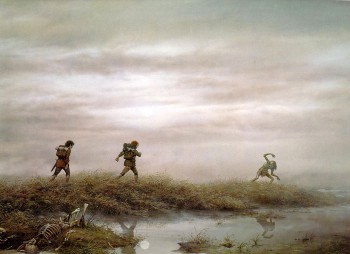
That J.R.R. Tolkien's inspiration for the locale of the Dead Marshes Same and Frodo pass through is routed in history, both his personal history and the world's?

Tolkien lived through both world wars, though by the second one me was an old man. During the first, however, he was young and served in the army for his country.

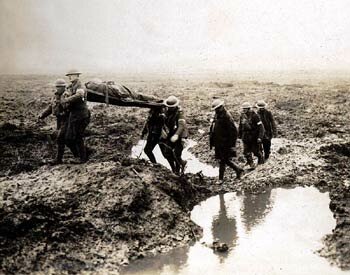
 If you know anything about WWI, you know how messy it was.  The military strategy hadn't caught up to the technology, with the result that hundreds--perhaps thousands--of young men were needlessly killed. For years, warfare had consisted of digging trenches for cover, and running out of them for attacks.  The problem was, WWI was the first major war that made use of things like machine guns and mustard gas. Given these weapons, the trench strategy was ludicrous! There was no advantage to it whatsoever and men on both sides were cut down without a prayer of life or victory.  Many harsh lessons were learned during this war.  It's one that even today fascinates and inspires because of the epic tragedy it engendered.

On the psychological side, things were even sadder.  While war always does a number on soldiers, this one was particularly nasty for them.  Not because it was any gorier than later wars, but because the soldiers were not prepared psychologically for what they would experience.  I don't think anyone ever can be, but in our case today, we know what's out there.  We have movies, the internet, the news, video games, books, etc that prepare us--at least somewhat--for what we might be facing should we choose to go to war.  That was not so with these boys.  Most of them were very honorable and went to war because they were loyal and nationalistic and wanted to fight for their country.  It wasn't so much that those attitudes changed, but that they were utterly ignorant of what it would be like on the war front.

Enter a young J.R.R.  Though it's hard to say what he felt about his experiences in WWI, what we know is that he made it out and lived a long, respectful life.  Though he didn't know it in his lifetime, he wrote what would become one of the most famous, inspirational fantasy epics ever penned.

Within that epic are clues to how his wartime experiences affected him.  The imagery he uses to describe the Dead Marshes in Book 2, The Two Towers is reminiscent of the horrors of the trenches.  In the chapter entitled, "The Passage of the Marshes," Gollum explains why they can see dead bodies in the water.  When you read the following excerpt, think of Tolkien's memories of WWI and the trenches.  The 'pools' are symbolic of the trenches themselves; the marshes of the filthy, muddy conditions the soldiers endured.  See what other parallels you can draw between Tolkien's words and WWI.

" 'They lie in all the pools, pale faces, deep deep under teh dark water.  I saw them: grim faces and evil, noble faces and sad.  Many faces proud and fair, and wees in their silver hair.  But all foul, all rotting, all dead...'

'Yes, yes,' said Gollum. 'All dead, all rotton. Elves and Men and Orcs. The Dead Marshes. There was a great battle long ago...Tall men with long swords, and terrible Elves and Orcses shrieking. They fought on the plain for days and months at the Black Gates. But the Marshes have grown since then, swallowing up the graves; always creeping, creeping...You cannot reach them, you cannot touch them...Only shapes to see, perhaps, not to touch.  No Precious!  All dead.' "

What do you think?